Food storage and freezer bags
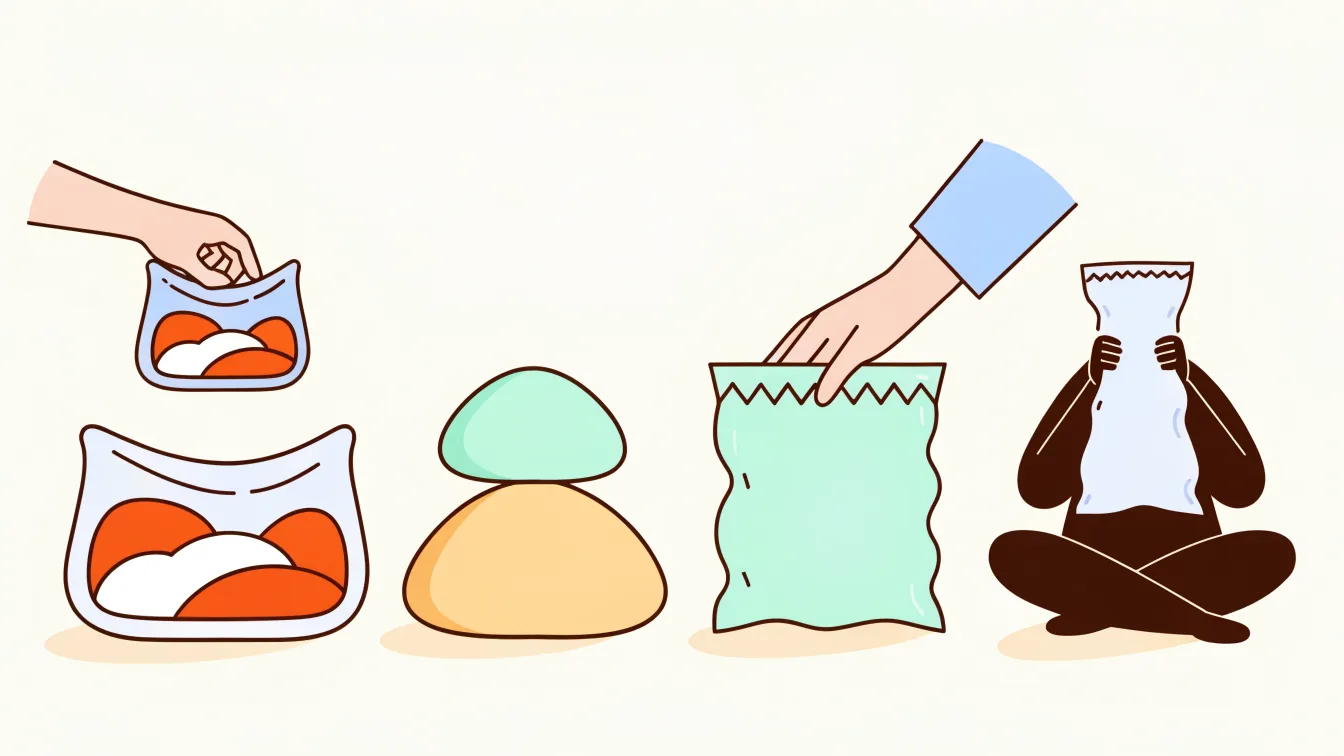
Freezer bags are food-contact pouches intended for frozen storage. Choose by permitted use, portion size and closure, then follow safe cooling and thawing guidance. Treat storage, freezing and heating as separate permissions rather than assuming one pouch covers every task.
When freezer bags differ from ordinary storage pouches
Read the intended-use directions before comparing capacity. A pouch labeled for room-temperature storage or refrigeration may have different directions from a version intended for freezing.
In one range, the ordinary quart pouch specifies room-temperature and refrigerator food-contact use. The quart freezer version additionally specifies freezing, despite sharing the same listed face dimensions.
| Format | Published use example | Detail to check | Source |
|---|---|---|---|
| General storage pouch | Pantry or refrigerator storage | Intended temperatures and food contact | Storage-pouch instructions |
| Freezer-designated pouch | Frozen food storage | Freezing directions and closure | Freezer-designated instructions |
| Expandable-base pouch | Portioning within a stated capacity | Base dimensions and fill directions | Half-gallon specification |
Do not infer use from appearance alone. Put the intended task beside the package directions: refrigerating tomorrow's lunch, freezing portions or carrying food to work.
For a reusable alternative, compare the separate silicone-food-bag guide. Read the exact model's temperature and cleaning instructions before changing materials.
Keep the package until you know the directions. If you transfer loose bags into a kitchen organizer, retain a clear way to identify each type.
Choose portions first, then compare sizes
Start with the amount you expect to use at one time. The National Center for Home Food Preservation recommends packing food in single-meal quantities.
| Named size example | Nominal US capacity, converted | Published dimensions | Source |
|---|---|---|---|
| Pint | About 0.47 liter | 7 × 5 inches | Pint-pouch specification |
| Quart | About 0.95 liter | 7 × 7⁷⁄₁₆ inches | Quart-pouch specification |
| Half gallon | About 1.89 liters | 10⁹⁄₁₆ × 5⅝ × 3½ inches | Expandable-base specification |
| Gallon | About 3.79 liters | 10⁹⁄₁₆ × 10¾ inches | Gallon-pouch specification |
These are individual published examples, not dimensions shared by every brand or closure style. Compare the bag opening and base construction as well as the nominal capacity.
For a batch of cooked food, decide the portions before choosing how many pouches to prepare. Write the portion on the label rather than relying on how full a flattened package looks.
Do not assume nominal capacity means filling a liquid pack to the zipper. Follow food-specific packing directions for expansion space.
Read material information without inventing temperature limits
Use the maker's material disclosure to understand the product, then use its instructions to decide what you may do with it.
One manufacturer's ingredient disclosure identifies low-density and linear-low-density polyethylene in a freezer pouch. It explains that different polyethylene densities are blended for different bag types.
That disclosure does not supply one universal temperature limit for every polyethylene product. Check the label for the particular bag and task.
Keep these questions separate when comparing packaging:
| Question | Information to look for | Decision it supports |
|---|---|---|
| Is it intended for food? | Food-contact use directions | Whether it belongs in this food-storage task |
| Is freezing permitted? | Explicit freezing instructions | Whether to use it for frozen portions |
| Is heating permitted? | Specific heating or microwave directions | Whether to transfer food before heating |
| Is reuse permitted? | Cleaning method and exclusions | Whether another use is allowed |
Glad's FAQ advises against storing food in its trash bags. Do not substitute a clean waste liner for food-contact packaging.
For terminology across different constructions, use the bag-materials guide. Apply the finished product's directions rather than generalizing from a polymer name.
Cool food promptly before filling suitable pouches
Follow both food-safety guidance and the pouch's filling instructions. A manufacturer's instruction to cool food before bagging does not mean leaving perishables on the counter.
The FDA says hot food can go into the refrigerator in shallow containers for quicker cooling. The pint-pouch instructions say to let food cool before placing it in the bag.
Use a suitable cooling container first, then transfer cooled portions into the appropriate pouch. Federal guidance sets a 2-hour refrigeration limit, reduced to 1 hour above 90°F. Refrigerate promptly rather than treating that limit as a target waiting time.
Prepare a clean work area before portioning. The CDC recommends washing hands for at least 20 seconds and keeping raw foods separate from ready-to-eat foods.
Identify which portions are raw and which are ready to eat before labeling. Follow the federal guidance to contain raw meat, poultry and seafood in sealed, leakproof packaging.
Arrange the work so cooled portions can return to cold storage promptly. Prepare labels and suitable bags beforehand instead of searching for supplies while perishable food waits.
Leave appropriate space, seal and label
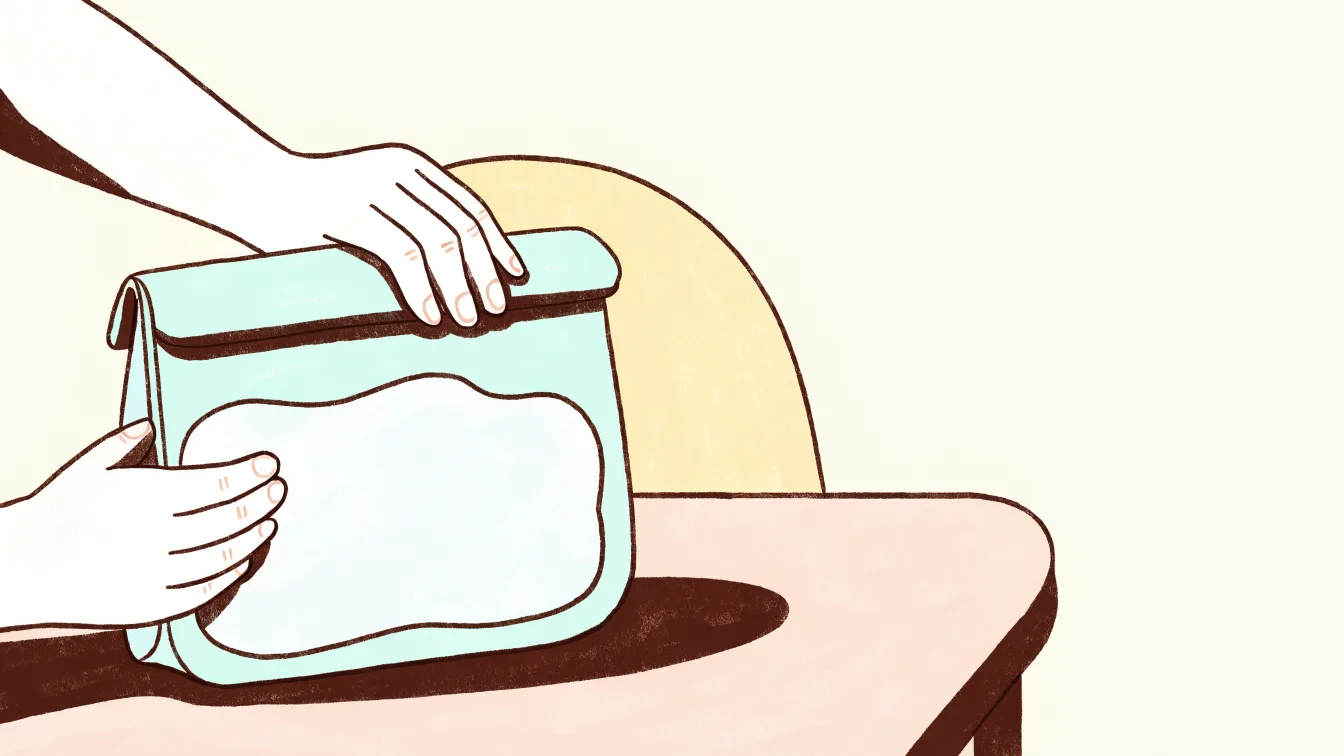
Use the preparation directions for the actual food. The National Center for Home Food Preservation recommends reducing trapped air while allowing required headspace for expansion.
Those are separate checks. Do not squeeze a liquid portion up to the closure merely to remove an air pocket. Use food-specific guidance instead of a universal headspace measurement for every pouch.
Follow the bag's closure directions after filling. Before cold storage, confirm that you have joined the seal as instructed and that the intended label is readable.
| Label field | Example wording | What it records |
|---|---|---|
| Food and form | Cooked tomato sauce | Identity and preparation state |
| Added ingredients | Includes milk | Information about the actual recipe |
| Packaging date | Date packed | When this portion entered the system |
| Quantity | Two portions | Amount intended for use |
Use accurate recipe information rather than copying an example label. Keep raw and cooked portions clearly distinguished.
Place each group where you can identify it again without opening every pouch. Maintain an inventory if you prepare several recipes or portion sizes together.
Keep storage temperatures and time guidance separate
Use an appliance thermometer rather than assuming the control dial shows the actual temperature. The FDA recommends 40°F or below for refrigeration and 0°F for the freezer.
Next, consult food-specific storage guidance. FoodSafety.gov distinguishes refrigerator limits from freezer quality guidance, with frozen guidance based on continuous storage at 0°F or below.
| Food example | Refrigerator guidance | Freezer quality guidance | Source |
|---|---|---|---|
| Raw ground meat | 1–2 days | 3–4 months | Federal cold-storage chart |
| Soups and stews | 3–4 days | 2–3 months | Federal cold-storage chart |
| Cooked meat or poultry leftovers | 3–4 days | 2–6 months | Federal cold-storage chart |
A bag's marketing claim should not replace that food-specific guidance. Record the packed date and use the chart for the actual item.
For travel between home and work, use an appropriate cooler bag and a food-safe temperature plan. A closed pouch should remain part of the cold-storage routine rather than replace it.
Thaw safely and follow the exact reuse instructions
The FDA identifies refrigerator, cold-water and microwave thawing as safe methods. Do not thaw perishable food on the counter.
For cold-water thawing, use intact, leakproof packaging and submerge the packaged food in cold tap water. A zipper alone does not establish that a pouch is leakproof. The preservation center limits this method to food that thaws within 2 hours while the water stays below 70°F.
Change the water every 30 minutes to keep it cold. Cook immediately after cold-water or microwave thawing.
Follow the pouch's permitted uses as well. Transfer food to an appropriate dish when the bag does not explicitly permit the intended heating method.
After emptying, apply the specific cleaning directions. One half-gallon model permits hand-washing and air-drying but excludes reuse after raw meat, fish, eggs or potentially allergy-triggering foods.
Do not extend that permission to another model without reading its instructions. Inspect any bag intended for reuse and follow the maker's directions for damaged items.
Keep the use cycle straightforward: identify the food, follow safe storage and thawing guidance, then decide whether the emptied pouch may be reused. Retain the instructions where everyone using the kitchen can find them.
FAQ
Can I use ordinary storage bags instead of freezer bags?
Read the exact product's permitted uses. In one range, the ordinary storage pouch specifies room-temperature and refrigerator use, while the freezer-designated version includes freezing. Choose from those directions rather than appearance, dimensions or the fact that both products close with a zipper.
Should hot leftovers cool on the counter before bagging?
Refrigerate promptly in suitable shallow containers rather than waiting on the counter. The FDA permits hot food in the refrigerator.
Then follow the pouch's specific filling directions. Federal guidance limits unrefrigerated perishables to 2 hours, or 1 hour above 90°F.
How full should I fill a liquid portion?
Follow the food's freezing directions and the bag's fill instructions. The National Center for Home Food Preservation explains that most foods need expansion space, while also recommending minimal trapped air. Do not apply one headspace measurement to every pouch, recipe or nominal bag size.
Can I wash and reuse a pouch?
Check the model's directions and what it held. One maker permits hand-washing and air-drying but advises against reuse after raw meat, fish, eggs or potentially allergy-triggering foods. Follow those exclusions and do not assume another pouch carries the same reuse permission or cleaning method.
Can I thaw a sealed portion on the kitchen counter?
Use refrigerator, cold-water or microwave thawing, not the counter. For cold water, submerge intact, leakproof packaging and change the water every 30 minutes. Follow the food-specific limits and preparation guidance described above.
Cook immediately after cold-water or microwave thawing. Use an appropriate dish if the pouch does not permit the heating method.
Related guides
Sources
- nchfp.uga.edu/how/freeze/freeze-general-information/thawing-and-preparing-foods-for-ser…
- ziploc.com/en-us/products/bags/freezer/medium
- ziploc.com/en-us/products/bags/storage/medium
- ziploc.com/en-us/products/bags/freezer/small
- ziploc.com/en-us/products/bags/freezer/large
- ziploc.com/en-us/products/bags/freezer/ziploc-freezer-half-gallon-bags
- whatsinsidescjohnson.com/en-us/brands/ziploc/bags/freezer/ziploc-freezer-quart-medium-bags
- glad.com/faq
- fda.gov/food/people-risk-foodborne-illness/tips-chill-food-food-safety-moms-be
- fda.gov/food/buy-store-serve-safe-food/refrigerator-thermometers-cold-facts-about-food-…
- foodsafety.gov/keep-food-safe/4-steps-to-food-safety
- foodsafety.gov/food-safety-charts/cold-food-storage-charts
- nchfp.uga.edu/how/freeze/freeze-general-information/packaging-and-labeling-foods
- cdc.gov/food-safety/prevention