Medical bags: types and organization
Medical bags carry first-aid supplies, medicines or clinical gear. Choose one for its role: a personal first-aid kit, a work organizer or a travel medication pouch. A good one keeps supplies easy to find and clean items apart from used ones.
What is a medical bag?
The term covers several different jobs, from organizing personal supplies to transporting equipment for authorized clinical use. A first-aid pouch holds a selected kit. A nurse tote may simply carry personal shift belongings, while a professional response case serves a defined equipment list.
A travel medicine organizer keeps containers and documents together. It does not tell you which medicines to pack or how to store them.
Choose the role before choosing the size. Start with the approved inventory and the manufacturer's packaging. The bag should fit them without making you remove labels or force rigid items into narrow pockets.
For a workplace purchase, ask who defines the inventory, who refills it and who cleans the carrier. Those responsibilities affect the layout. A shared bag needs an understandable system even when its usual owner is absent.
Which medical bags serve which purpose?
| Type | Intended use | Useful organization | Critical limitation |
|---|---|---|---|
| Personal first-aid pouch | Everyday minor-event readiness | Clearly separated essentials | Contents depend on user and activity |
| Travel health kit | Trips and remote access | Labeled medicine section and documents | Different countries restrict medicines |
| Nursing or work tote | Personal shift essentials | Secure pockets and wipe-clean surfaces | Workplace infection-control rules still apply |
| Professional supply backpack | Organized equipment transport | Segmented compartments and rigid protection | Cleaning and equipment rules govern use |
| Emergency response case | Rapid retrieval by authorized users | Easily identifiable modules | Requires training and approved procedures |
| Temperature-controlled carrier | Items with a stated temperature range | Proven, documented temperature control | An ordinary insulated bag has no proven range |
A small everyday kit should be organized by retrieval, not appearance. Open the bag and ask whether supplies can be located without emptying the entire container. A complicated system of tiny pockets may be slower than a few clearly labeled compartments.
For travel, a separate medicine section makes checking labels and documents easier. The CDC's travel health-kit chapter emphasizes tailoring the kit to the traveler and destination. It does not prescribe one bag size for everyone.
In clinical work the bag's job is narrower: it carries personal shift items and whatever equipment the employer allows. Extra compartments do not make a fashion tote suitable for patient-care equipment. For named totes and backpacks sized for a shift, see best work bags for nurses.
Size and features: published examples
These are makers' stated capacities, not standard sizes. Liters do not tell you whether your items fit, so measure the actual packages and the opening before ordering.
| Bag role | Published capacity | Relevant organization | Scope of the example |
|---|---|---|---|
| Personal nurse tote | One maker states 18 liters | Zipped mouth, interior pockets and padded underside | Personal shift belongings; no clinical-cleaning certification implied. Maker description |
| Portable medicine organizer | One maker states approximately 1.3 liters | Separate front and rear pockets, plus a transparent rear pocket | Designed for a diabetes kit; capacity is not validated temperature performance. Maker specifications |
For a small first-aid pouch, look for a roll-top closure or a clear window that lets you check contents without unpacking. Size the pouch to the supplies you carry.
When comparing options, distinguish capacity from clear interior dimensions, since dividers and padding take up space. Measure each original container and any required protective case, leaving room to lift one item out. If a rigid device needs a particular cavity, ask for that measurement directly.
Materials and cleaning
A smooth, coated surface is easier to wipe down than textured cloth. But "wipe-clean" on a label does not mean the fabric tolerates every disinfectant. Check the bag maker's chemical compatibility instructions and follow the clinical facility's infection-control protocol.
| Material or feature | What it tells you | What remains to check |
|---|---|---|
| Typical: coated nylon on a roll-top first-aid pouch | A smooth inner surface to ask cleaning questions about | Compatibility with the intended cleaning method |
| Typical: clear window on a first-aid pouch | Contents can be identified without opening | Window care and integrity around the attachment seam |
| Polyester-based shell | One maker identifies polyester-based textile constructions for a medicine organizer | Exact care instructions; no assumed disinfectant compatibility. Specification |
| Transparent PVC pocket | One maker lists this rear-pocket material | Whether the pocket is suitable for the intended contents. Specification |
The CDC core practices say reusable medical equipment must be cleaned and reprocessed according to manufacturer instructions. They add that clean and soiled equipment should be kept separate. That is a rule about handling equipment, not about bag fabric.
If the bag itself becomes contaminated in a clinical setting, use the employer's designated process. Do not improvise a home cleaning method for it.
For an ordinary personal first-aid pouch used outside clinical care, follow the bag's care label. Empty it, inspect seams and removable dividers, and clean only as instructed. Dry thoroughly before replacing supplies.
At the same time, check the handles, closures and base seams of medical bags. A failed strap matters more when the bag carries important equipment. Replace the bag once its load-bearing structure or protective features are compromised.
TSA medication screening and bag access
TSA allows medically necessary liquids above the usual 3.4-ounce limit in carry-on bags. Its medication FAQ says to remove them for separate screening and recommends clear labels.
TSA's medical-conditions page limits them to reasonable quantities for your flight. Tell the officer about them before screening begins. If one alarms, additional screening is required.
Solid medicines are screened too: the same page says medication can undergo visual or X-ray screening. Rules checked November 2026; confirm them on tsa.gov before you fly.
Arrange the organizer so you can present the relevant items and documents without scattering everything else. For where it sits in your carry-on, see packing guides. Airport screening rules do not replace destination laws or storage instructions; those come next.
Travel medicine storage is a separate decision
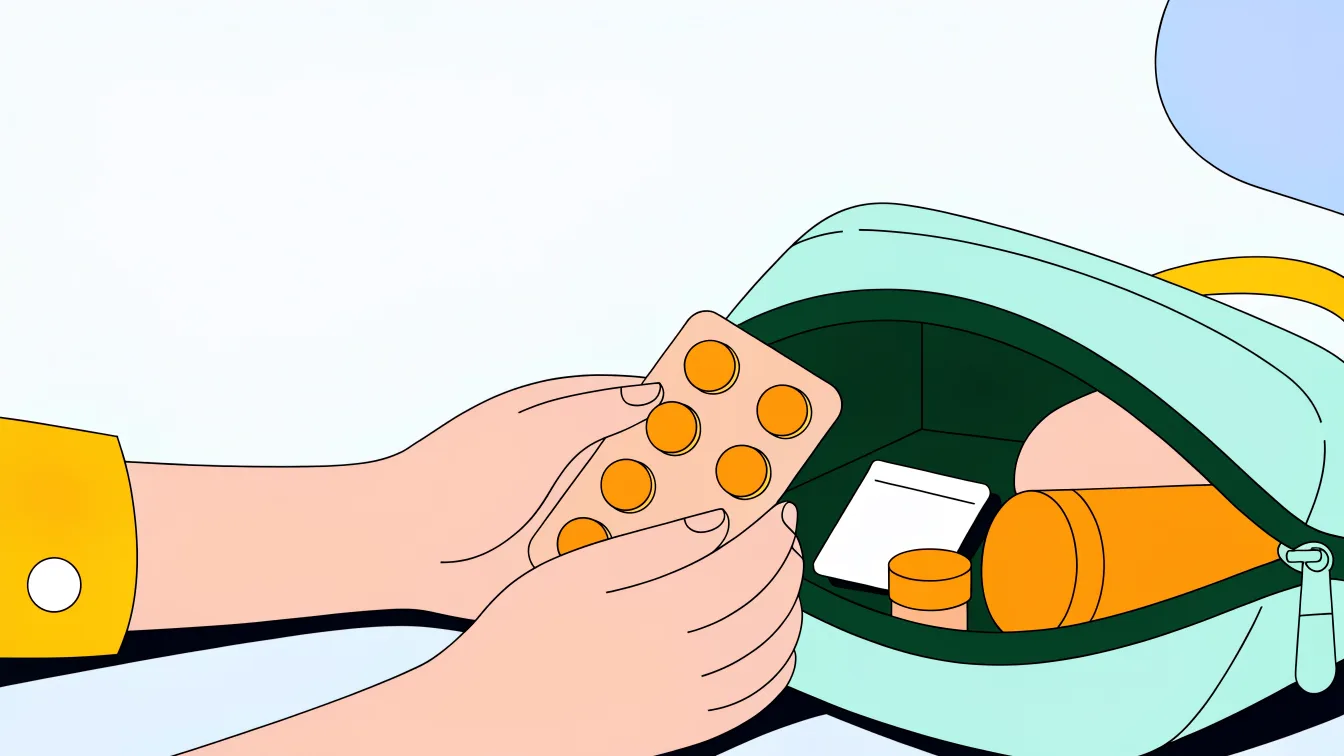
A medicine organizer can help with daily routines, but international rules may make original packaging important. The CDC's international medication guidance advises travelers to keep medicine in original labeled containers and carry them in cabin baggage. It also warns that legal restrictions differ by destination and transit country.
An unlabeled pill pouch may not be acceptable at every border crossing. Ask a healthcare professional or pharmacist about medication-specific storage, documentation and dosing schedules. For international travel, check the destination's current medication rules before departure.
Temperature-sensitive items need more than a generic cooler bag. Look for product-specific handling requirements, validated transport equipment when necessary, and guidance from the prescribing team. A marketing claim such as "insulated for hours" is not a substitute for a documented temperature range.
Organizing a first-aid pouch around a recognized list
The American Red Cross list includes dressings, adhesive bandages, tape, gloves, a breathing barrier, an emergency blanket and instructions. It also includes personal items and emergency contacts. Recognized kit list
Use that list as an inventory reference and ask a professional about individual needs. The layout below does not explain treatment or replace first-aid training.
| Suggested section | Examples from the recognized list | Packing task |
|---|---|---|
| Flat packaged supplies | Dressings, adhesive bandages and gauze | Keep wrappers visible and uncompressed |
| Protective items | Nonlatex gloves and breathing barrier | Give them a clearly labeled location |
| Larger folded items | Emergency blanket and triangular bandages | Check access without pulling out the whole kit |
| Reference section | Emergency instructions and contact information | Keep text readable and accessible |
The item examples above come from the American Red Cross list. Compartment labels and layout are editorial suggestions, not a Red Cross packing standard.
Place an inventory card where it can be checked without emptying the bag, and record missing items after use rather than trusting memory. The Red Cross recommends regular checks and replacement of used or expired contents. Review the layout after refilling so nothing migrates into an unexpected pocket.
Organize by how items are used
Keep the supplies you need fastest in their own obvious spot, away from loose personal items. Use readable labels on removable pouches. Group items by function rather than by package color, which can change between brands.
| Section | Suitable contents | Storage concern |
|---|---|---|
| Personal documentation | Contacts, relevant information | Privacy and access |
| Sealed basic supplies | Manufacturer-packaged permitted items | Packaging integrity |
| Routine personal medicines | Original labeled containers when traveling | Temperature and legal requirements |
| Small nonmedical accessories | Pens, notebook, phone charger | Keep apart from clean supplies |
| Used or contaminated items | Only as allowed by facility procedure | Do not return to clean storage |
Organization should cut searching and handling, so skip an elaborate color code nobody else understands. If more than one authorized person may use the kit, give it clear labels and an agreed inventory list.
Check packaging before every refill. An open or damaged sterile package should not be treated as protected because it sits inside a zipped pouch. Follow product and institutional instructions for replacement and disposal.
Which medical bag should you choose?
- Home, car or day-hike first aid: a small labeled pouch, roll-top or clear-window, with an inventory card.
- Shift work: a zip-top tote or backpack with wipe-clean surfaces (the cited tote is 18 liters), within your employer's rules.
- Travel with medicines: an organizer that holds the original labeled containers and stays in your carry-on.
Then check the bag in this order:
- Define the job before choosing the bag style.
- List every item the bag has to carry.
- Measure rigid equipment and original medication packages.
- Separate clean storage from personal items and any used equipment.
- Check closure security, labels, access and cleaning instructions.
- Confirm temperature requirements separately for sensitive items.
- Review the inventory and packaging condition at regular intervals.
Do not force a rigid medical device into a soft pouch just because the zipper closes around it. Padding protects against casual bumps, but it does not certify transport safety or prevent damage from heavy loads. Use the device manufacturer's approved carrying guidance when one exists.
What not to put in an ordinary medical bag
Loose used sharps, contaminated disposables and unidentified medicines do not belong in a general-purpose pocket; use approved containers and procedures for hazardous materials. A thick divider does not make it safe to mix clean supplies with dirty work items.
Avoid keeping liquids against paperwork or electrical equipment without proper containment. Check whether the bag's lining can actually resist leaks. An unsealed zipper is not a spill-control system.
Check the handling instructions and travel restrictions before putting temperature-sensitive medicines in checked luggage. For personal health needs, ask the pharmacist, clinician or equipment provider.
FAQ
What is the best bag for a basic first-aid kit?
A clearly organized pouch sized for the supplies your activity calls for. Choose secure closures and a material you can clean as instructed. Kit contents should follow recognized guidance and individual needs, not a universal bag checklist.
Can I put medicines in a pill organizer for flights?
Rules depend on the destination and any transit countries. For international trips, the CDC advises keeping medicines in their original labeled containers and in your carry-on. Confirm each medicine's rules and paperwork before you travel.
Are wipe-clean nurse bags infection-proof?
No. A wipe-clean surface is easier to clean; it is not an infection-control rating. Follow your healthcare facility's cleaning, separation and equipment-handling procedures, including written manufacturer instructions.
Can an insulated pouch transport temperature-sensitive medicine?
Not without confirming the medicine's temperature limits and the carrier's validated performance for that use. Ask a pharmacist or prescribing professional what transport method is appropriate. Ordinary insulation is not temperature control.
How often should I check a medical bag?
Set a schedule based on the kit's use, facility rules and manufacturer instructions. Inspect packaging, expiration dates, compartment condition and cleanliness. A rarely used travel kit still needs review before a trip.
Related guides
- Best work bags for nurses for shift totes and backpacks
- Work bags for nurse and shift totes with laptop and document space
- Travel bags for trip luggage
- Bag care for cleaning by material
- Bag sizes for measurement basics
Sources
- cdc.gov/yellow-book/hcp/preparing-international-travelers/travel-health-kits.html
- cdc.gov/yellow-book/hcp/travelers-with-additional-considerations/traveling-with-prohibi…
- cdc.gov/infection-control/hcp/core-practices
- boundarysupply.com/blogs/news/the-ideal-nurse-tote-bag
- elitebags.es/en/product/dias-cool-en
- tsa.gov/travel/frequently-asked-questions/i-am-traveling-medication-are-there-any-requi…
- tsa.gov/travel/tsa-cares/disabilities-and-medical-conditions
- redcross.org/get-help/how-to-prepare-for-emergencies/anatomy-of-a-first-aid-kit.html