Military origins of everyday bags

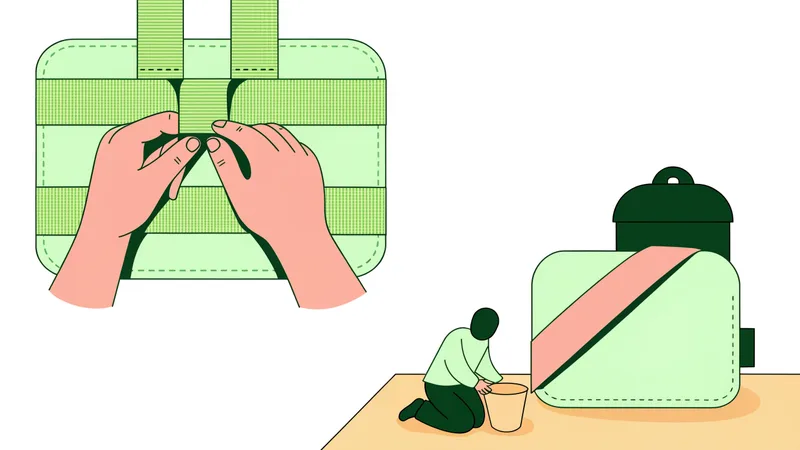
One clear link in military bags history is the Army's pouch attachment, which later appeared on civilian camping gear. The National Army Museum's framed rucksack illustrates how troops carried equipment on foot when vehicles could not follow.
A timeline of military bags history
These dates mark different kinds of evidence: a word, surviving equipment, and a patented attachment. They should not be treated as interchangeable invention dates.
| Date | What happened | Source |
|---|---|---|
| 1677 | The earliest use recorded here for “duffel” concerns coarse woolen material. | Merriam-Webster |
| Around 1860 | A telegraph messenger crossbelt and pouch provides a civilian work example of body-carried message equipment. | National Postal Museum collection |
| Around 1916 | A British South Africa Police officer's kit bag and a Royal Army Medical Corps document carrier survive. | Kit bag, Rippon's document carrier, inventory 1964-04-31 |
| Around 1944 | The museum dates its War Department issue 1941 Bergen rucksack to this period. | Bergen record |
| 1996–1998 | An Army-assigned interlocking strap design moves from filing to patent grant. | US5724707A |
Together, the examples separate bulk storage, carrying equipment on the back, transporting documents, and attaching smaller pouches. Everyday bags can combine these functions within one object.
One connection runs from military packs to the campsite. The Army developed an attachment for removable pouches as part of its Modular Lightweight Load Carrying Equipment (MOLLE). The Army's history traces that same attachment to civilian camping gear.
Duffel: a fabric name and a military kit bag
Start with the word. Merriam-Webster identifies duffel as a coarse, heavy woolen material and traces the name through Dutch to Duffel, Belgium. It also records meanings for portable belongings and a duffel bag. Dictionary entry
That makes the fabric's recorded date a poor substitute for the invention date of a bag. The material, the belongings, and the container are related meanings, but they are different things.
For a military object, consider Captain Alexander Wallace's kit bag. The National Army Museum dates it to around 1916 and describes brown webbing, top eyelets, and a missing drawstring. Wallace served as a medical officer with the British South Africa Police. Kit bag record
The closure gives the comparison its focus. A gathered top organizes access differently from a long opening along a bag's side. Calling both containers duffels should not erase that difference.
The duffel bags guide covers the broader category. The historical connection here rests on a named service object, rather than a claim that every present-day duffel descends from it.
Rucksacks: the problem was carrying equipment on foot
The Bergen in the National Army Museum is more specific than a generic military backpack. Its title identifies War Department issue 1941, while the object itself is dated around 1944. Bergen rucksack
The museum explains that this metal-framed type served troops without following transport vehicles. Their missions required equipment that could not fit within the large pack or haversack. This connects the design to a particular transport problem. Museum explanation
The important relationship is between the carrier and the equipment available to support them. A bag accompanying a vehicle and a bag carried throughout a journey answer different needs.
The frame also gives you something concrete to compare. Consider it separately from the fabric body, the opening, and any external pockets. “Rucksack” alone does not describe all those parts.
For the larger story, the history of the backpack follows other back-carried forms. This military example belongs within that history; it does not require treating every framed pack as the descendant of one wartime pattern.
Document bags explain one branch of messenger-style carrying

Not all military carrying involved a large load. The National Army Museum lists a document case or haversack owned by Private Valentine Rippon, Royal Army Medical Corps, around 1916. Collection inventory
Its leather and khaki drill construction included pockets and two internal divisions. A buckle fastened it, and a webbing strap suspended it. Those details describe organized contents and a strap-carried container within a military setting. Object description
The link with a messenger-style bag is a comparison of arrangement, not a documented family tree. Rippon's buckle closure, webbing strap, and two internal divisions show how he could secure, carry, and organize documents.
It is worth keeping “document case” in view too. That name points toward contents, while “shoulder bag” points toward carrying position. One object can satisfy both descriptions.
The messenger bags guide explains the everyday category. The historical lesson is narrower: military personnel used organized, strap-carried document containers, alongside their other equipment.
Civilian messengers complicate a single-origin story
The National Postal Museum collection includes a telegraph messenger crossbelt and pouch dated around 1860. Its record identifies leather and metal and places it in the United States. Smithsonian collection record
That is a different working context from Rippon's document carrier. A telegraph messenger object sits within postal history, rather than serving as evidence for one exclusive military origin.
The distinction matters when looking at present-day bags. Similar carrying positions can respond to similar practical questions. Where should the container sit, and how should its opening face the person carrying it?
Those questions alone cannot identify a maker's inspiration. A familiar outline is a starting point for comparison, rather than proof of a direct borrowing.
Military bags history becomes more useful when it allows these parallel histories to remain visible. The history of bags provides the wider context. Compare modern messenger-style bags with military document carriers and civilian message equipment. Neither needs to become the sole ancestor of the entire category.
MOLLE offers a traceable attachment story
The evidence becomes more direct with an interlocking strap system. US patent 5,724,707 names John Kirk, Gerald E. Tatton, and Paul Dersain. The original assignee is the United States Department of the Army. It records filing on June 17, 1996, and grant on March 10, 1998. Patent record
The document describes attaching removable pockets or pouches to a textile surface. Its design problem is therefore the connection between components, rather than inventing an entire backpack. Patent description
This distinction explains why the attachment story deserves its own place in bag history. A container and its accessories can form a system. Changing the connector changes how those parts relate, even when the main bag remains recognizable.
Read the historical patent as evidence about the design being proposed. It is not a performance test of every later bag with rows of webbing.
The MOLLE guide explains the terminology used around this system. For historical purposes, the named inventors, recorded dates, and described connection provide a much firmer starting point than appearance alone.
What passed into civilian equipment?
The Army's DEVCOM Soldier Center identifies MOLLE as Modular Lightweight Load Carrying Equipment. Its historical account places the interlocking pocket attachment's development in 1996 and its patent in 1998. Army account
More significantly, the Army explicitly connects that attachment system with civilian uses. It names camping gear, dog harnesses, and sport utility vehicle interiors. This supplies a documented military-to-civilian link for the attachment concept. Civilian applications
Compare that evidence with the earlier bag examples. The kit bag establishes service use. The Bergen links a form with a carrying problem. The document carrier supports a comparison with organized shoulder bags. MOLLE adds an explicit account of a technology reaching civilian equipment.
Those are different strengths of connection, and each tells something useful. None requires assuming that a military appearance guarantees suitability for an everyday task.
When browsing tactical bags, separate the main container, carrying arrangement, and attachment system. The history behind one component does not automatically describe the origin or capabilities of the whole bag.

FAQ
Was the duffel bag invented in 1677?
The dictionary's 1677 date concerns the woolen material meaning of “duffel.” It does not date the invention of the bag. The word's connection with Duffel, Belgium, explains an etymology. A surviving service kit bag supplies a different kind of historical evidence. Merriam-Webster
What was a Bergen rucksack designed to do?
The National Army Museum describes its metal-framed Bergen type as equipment for troops without following transport vehicles. Their missions required carrying more than the large pack or haversack accommodated. That explanation concerns this military type and its intended role, rather than every object called a rucksack. Museum record
Are messenger bags exclusively military in origin?
The objects presented here support several work histories. Rippon's document carrier provides a military example, while a telegraph messenger crossbelt and pouch belongs to postal history. Comparing them explains useful similarities. It does not establish one exclusive origin for every later messenger bag. Military carrier, civilian messenger equipment
Does MOLLE have documented civilian uses?
Yes. The Army names camping equipment, dog harnesses, and vehicle interiors when describing the interlocking pocket attachment system's applications. That is a specific transfer story. It concerns a way of attaching components, rather than a claim that the military invented every bag carrying the feature. DEVCOM Soldier Center
Sources
- merriam-webster.com/dictionary/duffel
- collection.nam.ac.uk/detail.php
- collection.nam.ac.uk/detail.php
- collection.nam.ac.uk/inventory/objects/results.php
- collections.si.edu/search/record/ark:/65665/hm8e80b946630294e51b43facd82641982f
- patents.google.com/patent/US5724707A/en
- army.mil/article/283716/devcom_soldier_center_holds_third_annual_patent_award_and_innov…