How to measure a bag: liters, linear inches and dimensions
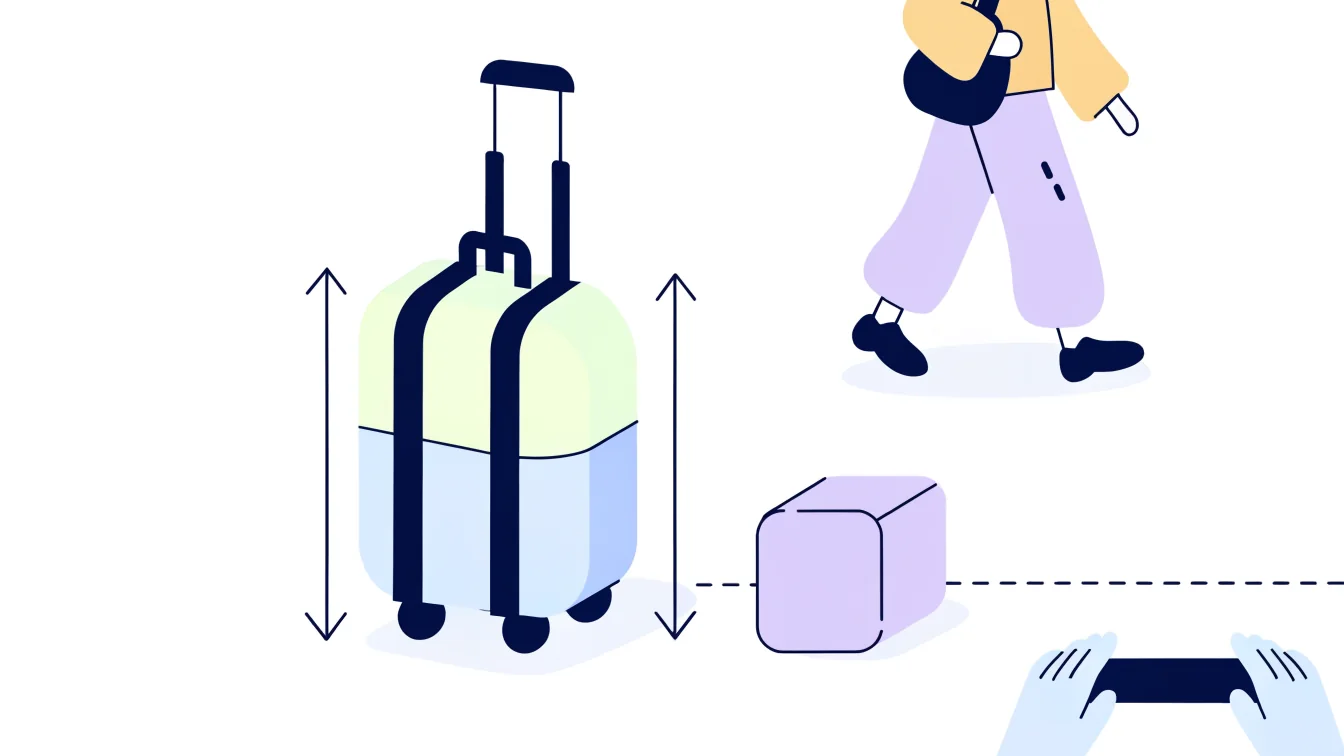
Knowing how to measure a bag starts with its outside height, width and depth at the widest points, including wheels, handles and other protruding parts. Add those three dimensions for linear inches. To estimate volume in liters, multiply usable interior dimensions in centimeters and divide by 1,000.
Three measurements answer different questions
When a label says 22 inches, it might mean the case body, a size class or the full outside height. Only the full outside dimensions, with wheels and handles, tell you whether the bag fits a sizer or a trunk.
Linear inches combine the three outside measurements for restrictions stated as a sum. Volume describes how much space the bag holds.
| Measurement | Calculation | What it tells you | What it misses |
|---|---|---|---|
| External height × width × depth | Measure outside at widest points | Sizer and storage compatibility | Interior shape |
| Linear inches | H + W + D | Overall combined size | Whether any one side is too long |
| Exterior box liters | H × W × D in cm ÷ 1,000 | Rough outer bounding volume | Wheels, shell thickness and pockets |
| Usable interior liters | Interior measurements and compartment volumes | Packing capacity estimate | Curves and irregular compartments |
| Manufacturer liters | Read stated nominal capacity | Product comparison starting point | Different measuring methods |
A bag can pass a linear-inch rule and still fail a separate limit on one side. Check both. An expandable case has two depths; measure it the way it will travel, expanded or not.
How to measure a bag in five steps
- Empty it. Close every zipper and retract any expandable gusset. Remove loose accessories unless they stay attached during travel.
- Set it upright on a level floor. Use a rigid tape measure or straightedge, not a fabric tape held diagonally.
- Measure total height. Go from the floor to the highest fixed point. Include wheels and fixed handles. Retract the telescoping handle.
- Measure width and depth. Measure the widest outside points, including side feet, pockets, hard handles or bulging compartments.
- Repeat while packed. Flexible bags can swell. Measure depth again after loading the items you intend to take.
Write the result as H × W × D and note whether the bag was packed or empty. Airline sizers are rigid boxes, so every bulge and knob counts. You can compare bags using the bag sizes hub and the suitcase size guide.
Worked example: linear inches for a suitcase
Suppose the outside of a suitcase measures 22 inches tall, 14 inches wide and 9 inches deep, including wheels and handles.
22 + 14 + 9 = 45 linear inches.
The sum is only half the check. American Airlines also caps each side, at 22 × 14 × 9 inches for a carry-on. A 24 × 12 × 9 inch case also equals 45 linear inches, yet its 24-inch side exceeds that particular airline's 22-inch height maximum.
Checked November 7, 2026: airline rules can change. Always confirm the carrier, route, fare and aircraft requirements before traveling.
Worked example: volume in liters

A simple rectangular interior is 50 cm long, 30 cm wide and 20 cm deep.
Volume = 50 × 30 × 20 = 30,000 cubic centimeters. Divide by 1,000 to get 30 liters.
This is an approximate interior-box calculation. Real bags have rounded corners, dividers, frame parts and padding. A hard-shell clamshell may divide its space into two shallow halves.
A backpack narrows at the top. The multiplication will not tell you how many shirts fit.
For imperial measurements, multiply three dimensions in inches to get cubic inches. Divide by approximately 61.024 to estimate liters.
For example, a theoretical 20 × 12 × 8 inch rectangular interior is 1,920 cubic inches, or about 31.5 liters. This is still an estimate, not a manufacturer-certified capacity.
Why the listed liters and your calculation disagree
A maker may calculate compartment volume differently from a buyer measuring the outer shell. Side pockets may count in the stated capacity; some divided interiors are difficult to capture with one rectangle.
Curved corners reduce usable volume. Soft bags can expand with the load while staying nominally the same capacity.
Compare similar bag types first. A 30L hiking pack, a 30L clamshell suitcase and a 30L duffel will not pack identically.
The number describes volume, not opening size, stiffness or the shape of objects inside. If you're choosing a backpack, use the backpack size chart rather than relying on volume alone.
What bag dimensions mean when you shop
Look for the words overall, external, body, and interior. If a maker provides only body dimensions, ask whether wheels and handles are included. If the page lists a collapsed and expanded depth, compare the larger one with the relevant limit when you expect to use expansion.
| Shopping situation | Which measurement matters most? | Extra check |
|---|---|---|
| Airline carry-on | Packed external H × W × D | Handles, wheels, exact airline |
| Personal item | Packed external H × W × D | Underseat shape and fare |
| Checked suitcase | External linear inches and weight | Airline weight allowance |
| Laptop backpack | Laptop compartment dimensions | Laptop actual width and thickness |
| Storage shelf | External H × W × D | Protruding straps and handles |
| Travel duffel | Packed outside dimensions | Soft sides bulging |
Once you know how to measure a bag, check the limits themselves in the airline baggage rules guide and the carry-on luggage guide.
Common measurement myths
A 22-inch suitcase always measures 22 inches tall. It might not. Sellers use different naming conventions; check overall dimensions.
Matching linear inches means it will fit. Not if the operator also specifies maximum lengths for individual sides.
An advertised 40L bag holds exactly 40L of rectangular objects. Capacity can be nominal. Packing access, dividers and shape reduce the space available for rigid items.
Soft bags do not need measuring. A packed soft bag may bulge past a sizer limit, especially at the zipper and front pocket.
FAQ
Do suitcase dimensions include wheels?
For airline carry-on checks, you should count wheels and handles. American Airlines explicitly includes them in its published dimensions.
Measure from the floor to the furthest external point, and repeat after packing. Go by the airline's published limits, not a seller's size label.
How do you calculate linear inches for luggage?
Measure the three external sides in inches. Add height, width and depth together.
For example, 22 + 14 + 9 equals 45 linear inches. Check any separate maximum for an individual dimension too; the sum does not override it.
How do you convert a bag's size into liters?
Multiply internal length, width and depth in centimeters, then divide the cubic-centimeter result by 1,000. This estimates the volume of a rectangular interior. Rounded corners, internal pockets and tapered walls will change the usable capacity.
Is a 30-liter backpack the same size as a 30-liter suitcase?
Both may advertise similar nominal volumes, but they need not have similar external dimensions or useful shapes. A backpack often has a taller, tapered body. A suitcase can have two shallow packing halves and thick shell walls.
Should I measure my bag full or empty?
Measure both. The empty size helps you compare products, but the packed size is what counts when you measure a bag for a flight. Soft fabric, expansion zippers and overstuffed pockets may change its width or depth after filling.