Courier and delivery bags
A courier bag carries deliveries, but parcels and prepared food call for different layouts. Choose around the largest package, the closure, and your carrying method. For food, add temperature control and cleanable compartments to that list.
Which courier bag matches your deliveries?
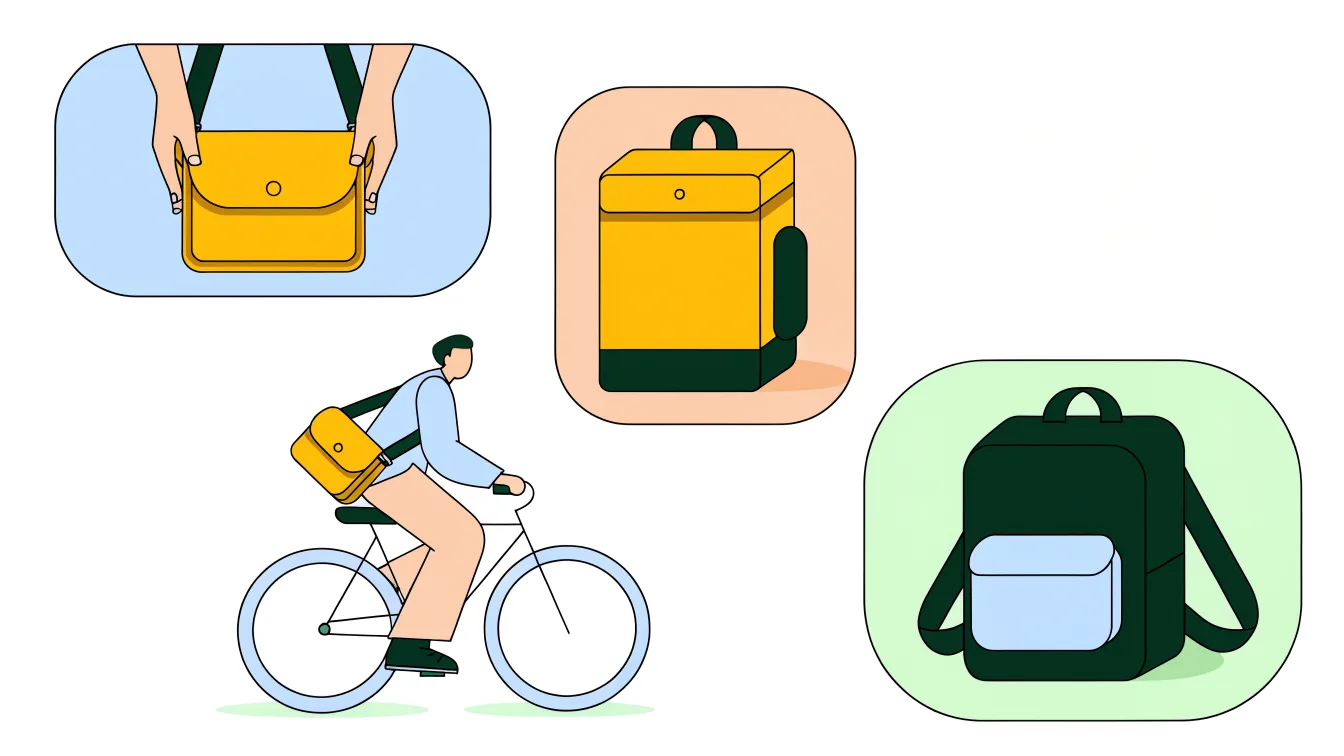
Start with the delivery, then choose the shape. A shoulder bag for envelopes needs a different layout from a backpack carrying upright takeaway containers.
The two insulated examples above have rigid internal supports and foam insulation. The roll-top example uses a backpack harness. Insulated construction, roll-top construction
Use this table to organize your shortlist. These are selection priorities, rather than performance guarantees.
| Format to consider | Load to plan around | Feature to examine | Question before choosing |
|---|---|---|---|
| Crossbody messenger | Documents and mixed parcels | Opening and adjustable strap | Can the largest package enter without forcing it? |
| Roll-top courier backpack | Parcels carried on your back | Harness and closure allowance | Can you close it correctly when loaded? |
| Insulated delivery backpack | Packed meals and beverages | Interior footprint and supports | Can containers remain in their required orientation? |
| Insulated hand carrier | Food transferred between stops | Handles and loading access | How will you secure it during travel? |
For crossbody shapes, begin with the messenger bags guide. If you expect to cycle, compare body-carried and bicycle-mounted arrangements.
Write down your normal load and your occasional largest load separately. Choose deliberately which one the bag must accommodate. Avoid paying for surplus space that serves no planned delivery.
What capacity and dimensions do you need?
Use liters to compare advertised volume, then use dimensions to assess fit. For rectangular packages, record length, width, height, and the orientation required during transport.
Published examples illustrate the difference between overall dimensions and usable interior measurements.
| Specification example | Published measurements | Measurement basis | Practical comparison |
|---|---|---|---|
| Roll-top parcel backpack | 19.7 x 15.4 x 6.1 inches; 39 liters | Listed bag dimensions and volume | Confirm the loading opening separately |
| Compact insulated backpack | 13 x 9 x 18 inches | Interior dimensions | Compare with packed containers |
| Large insulated backpack | 16 x 16 x 24 inches | Interior dimensions | Include container height and handling space |
Sources: parcel backpack, compact insulated backpack, large insulated backpack.
These are individual examples, not universal size categories. Do not interpret a table entry as a recommendation for a particular delivery.
For a hypothetical load, place the actual cartons together before measuring. Include lids, protruding handles, outer packaging, and anything you need between containers.
Then compare that arrangement with the bag's interior and opening. If you intend to add a divider, measure the arrangement with that divider included.
Keep your measurement method consistent between bags. Ask for internal measurements whenever a listing gives only the exterior.
How should closures and organization work?
Choose a closure around your loading routine. Imagine arriving at a pickup, opening the bag, placing the package, and securing everything again.
One insulated design has top access with a hook-and-loop closure. Another combines top access with a zipped side opening. Top-loading specification, side-access specification
For stacked meals, sketch how you would reach the bottom order. Decide whether removing everything above it would be acceptable during your actual route.
For parcels, reserve a specific place for paperwork and small essentials. Keep that arrangement simple enough to use without searching through unrelated packages.
Make full closure a condition of fit. The parcel backpack example requires three to four downward rolls, secured afterward, for its stated IP64 protection. Closure instructions
Do not treat unused fabric above the load as spare capacity until you understand the closing instructions.
Also decide how you will identify separate orders. Use external labels or an organization method permitted by your delivery service. Keep customer packaging intact.
When comparing photographs, look beyond the number of pockets. Request a clear view of the loaded opening and the compartment you will use most.
Which materials and weather claims matter?
Read the shell, lining, support, and insulation descriptions separately. A material name alone should not decide the purchase.
Published constructions include PVC-coated polyester and coated woven fabric in a parcel backpack. An insulated example lists a nylon Oxford exterior, polypropylene boards, and 10-millimeter polyethylene foam. Parcel materials, insulated materials
Treat these as descriptions of construction. Do not turn them into an unsupported ranking of durability, comfort, or food safety.
For wet-weather work, look for a claim about the complete bag and the conditions attached to that claim. Check the opening, seams, and any separate pockets.
Record the maker's exact weather-protection wording so you can compare like claims.
Before choosing, make a short inspection list: closure instructions, interior access, removable components, and the maker's approved cleaning method. Request missing information before relying on a feature.
For deliveries that must stay dry, decide how to protect the package inside as well. Follow the sender's packaging requirements rather than improvising a promise to the recipient.
A shiny lining is a construction detail. It is not a delivery plan.
How should you carry it visibly on a bicycle?

Treat bag visibility as part of your riding setup. NHTSA recommends bright clothing by day, plus reflective gear and appropriate lights when visibility is poor. Visibility guidance
Its guidance specifies a white front light and red rear light and reflectors for nighttime or poor visibility. These are safety recommendations, checked November 2026. NHTSA
Assess the complete loaded arrangement. View it from the rear and sides, including any rain cover you plan to use. Keep lights and reflective features visible.
NHTSA also advises keeping both hands on the handlebars except when signaling. It recommends a backpack or items secured behind the rider. Carrying guidance
For riding, use that advice to guide your choice between a backpack and a suitable rear-mounted arrangement. Follow the bicycle and carrier manuals.
Try the intended load while stationary before setting out. Reject an arrangement that prevents normal control or access to the bicycle's controls.
A courier bag should serve the journey you actually make. Do not choose a carrying style solely because it looks associated with delivery work.
What changes when you deliver food?
Build the bag choice around the food business's handling procedure. Include the pickup temperature, required separation, route, and handoff arrangements.
FoodSafety.gov says hot and cold food should travel separately. It also recommends using a food thermometer to check delivered perishables. Food delivery guidance
Its consumer guidance gives 40°F or below for cold delivered perishables. It limits room-temperature exposure to two hours, or one hour above 90°F. Temperature and time guidance
These are general consumer safety guidelines, checked November 2026. Follow the food business's procedures and applicable local requirements for commercial deliveries.
Do not interpret those time limits as an acceptable route length. Plan around maintaining the required food conditions throughout the trip.
For selection, measure containers with any required cooling materials already included. Plan separate spaces or carriers for orders that require different conditions.
Ask how the inside can be accessed for cleaning, and obtain instructions for any removable components. Keep the cleaning routine practical enough to follow between uses.
Discuss the cleaning routine alongside the temperature-control plan. A generic insulated-bag description should never replace your operating procedure.
How do you choose and care for the bag?
Compare your shortlist against a written job description. Include package measurements, travel method, weather exposure, loading access, empty weight, and cleaning instructions.
Request the bag's own load limit. Do not translate a volume figure into a weight allowance, or borrow a limit from another model.
Before committing, rehearse the pickup and drop-off sequence with representative packaging. Include the space where you will put the bag while opening it.
After use, follow its care label and manual. The parcel backpack example permits mild-soap cleaning and requires complete drying before storage. It also warns against storing it folded. Care instructions
Apply those instructions only to that construction. Obtain separate guidance for an insulated carrier with internal boards, foam, or removable fittings.
Inspect closures, attachment points, handles, and the interior as part of your routine. Ask the maker about repair options if a component no longer works as intended.
For food carriers, arrange the cleaning routine with the food business. Avoid choosing a complicated interior unless you can maintain it according to its instructions.
Keep the specifications and care instructions with your work records. They provide a useful reference when replacing components or choosing another bag.

FAQ
Can I use a normal backpack for food delivery?
Choose around your delivery procedure rather than the backpack label. Compare the interior with packed containers, required separation, and cooling materials. Federal guidance says hot and cold foods should remain separate during delivery. Use a carrier that supports the food business's handling plan. Food delivery guidance
What size courier bag do I need?
Measure your largest routine package in its delivery orientation, including outer packaging. Compare it with usable interior space and the opening. Leave the closure allowance required by the manual. Decide separately whether occasional oversized jobs justify a larger bag or a different transport arrangement.
Is a reflective bag enough for riding at night?
Plan a complete visibility setup. NHTSA recommends reflective gear alongside a white front light and red rear light and reflectors at night or in poor visibility. Examine your setup with the bag loaded, and keep those features visible. Follow the instructions for your bicycle and lighting equipment. NHTSA guidance
How do I choose between a messenger and a delivery backpack?
Start with your travel method and package shape. Compare access, closure, and the loaded carrying arrangement. For cycling, NHTSA recommends carrying items in a backpack or secured to the bicycle's rear. Use that guidance when deciding how deliveries will travel, then follow the relevant equipment manuals. NHTSA guidance